There is a moment in every demo where someone leans forward slightly and asks the real question: what happens when it gets it wrong?
It is the correct question, and the answer is more reassuring than most people expect, because the part of the system that could ruin a customer relationship does not use artificial intelligence at all.
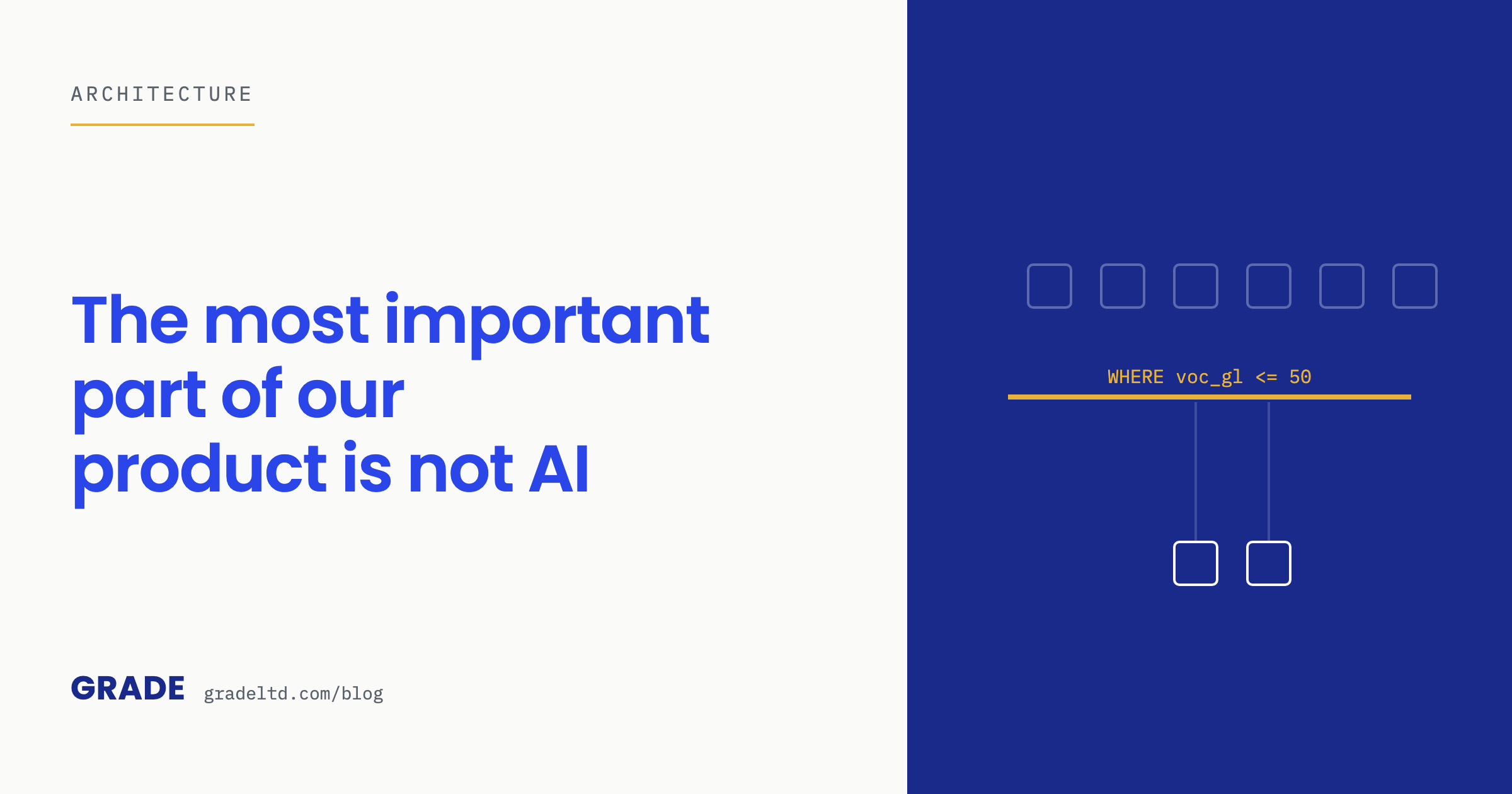
Here is how a request moves through GRADE. A language model reads the customer's inquiry and extracts the requirements — a maximum particle size, a banned chemistry, an application. That is a reading task, and models are good at reading. Then the requirements are applied to the catalogue as database filters. Exact comparisons. A grade with a top-cut of 149 microns fails a 20-micron ceiling, every time, in the same way, because that is what a comparison operator does. Finally, a model drafts a reply from the products that survived.
The model reads and writes. It does not decide what passes.
This matters because of how models fail. A language model asked to judge whether a product meets a specification will usually be right, and occasionally, confidently, be wrong. In most software, an occasional confident error is an annoyance. In specialty chemicals, recommending a grade that violates a stated regulatory constraint is not an annoyance. It is the end of a customer relationship, and possibly a compliance problem.
So we took that decision away from the model.
The consequence is a guarantee we can actually make. No product that violates a constraint we correctly extracted appears in the results. The deterministic filter cannot drift, and we verify it continuously against generated test cases — over a million, re-run nightly — with zero screening failures. The hardest part is the reading step before the filter: a constraint the system misreads is one the filter never sees, which is why a value that can't be traced to the source document is put in front of a human rather than guessed.
The second consequence is that we can say "I don't know." If a data sheet does not state a value the customer constrained, the product does not quietly pass. It lands in an unknown bucket and a human is told. Guessing would produce a cleaner-looking answer and a worse one.
There is a fashion in software right now for describing products as intelligent, autonomous, and always learning. In an industry where a specification is a contract, those three words describe a system nobody can validate. What a technical buyer wants is the opposite: something that behaves identically today and next Tuesday, that shows its reasoning, and that changes only when someone deliberately releases a change that passed its tests.
That is a less exciting sentence. It is also the reason the product is worth trusting with an inquiry that matters.