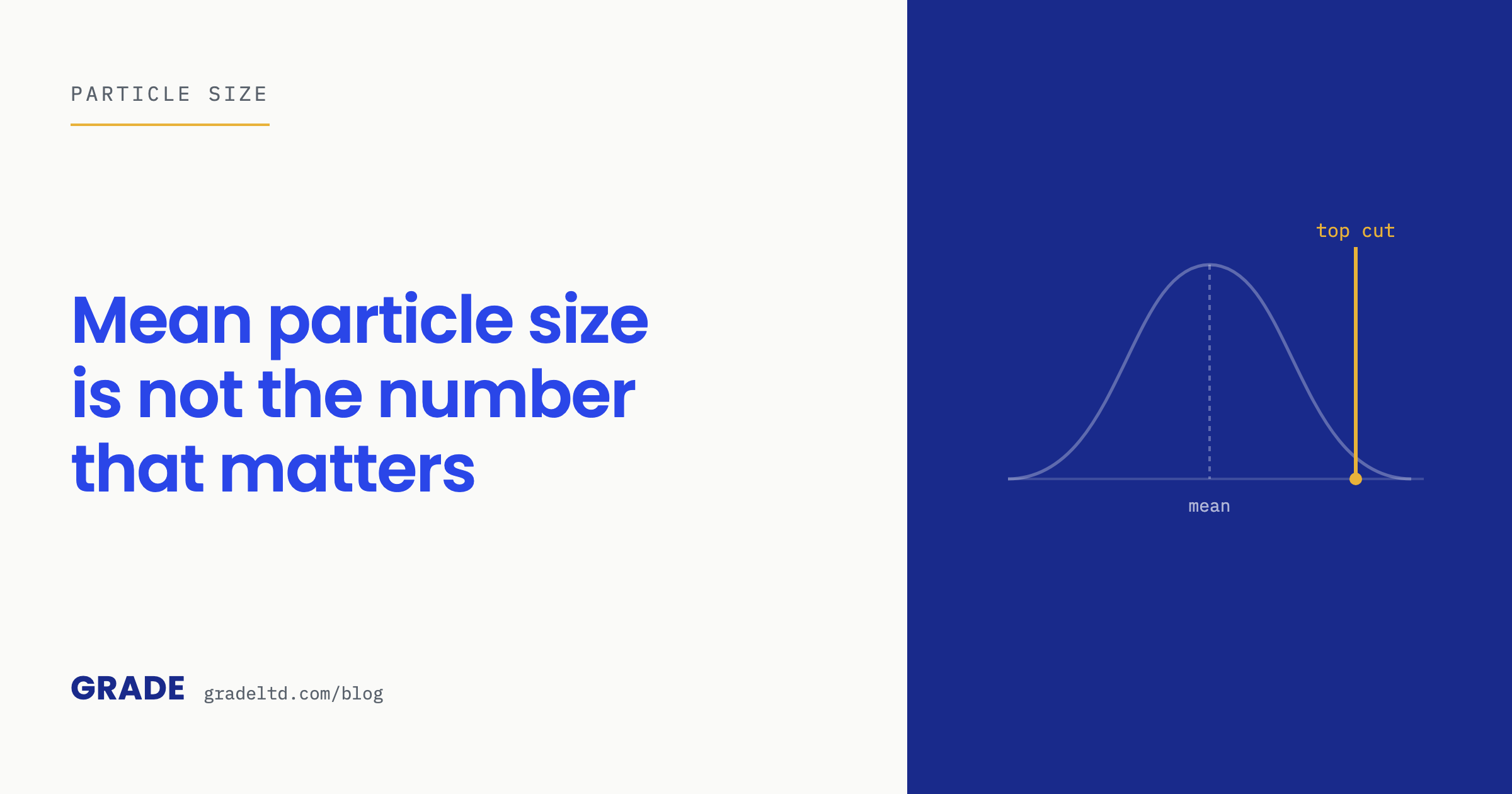
A customer says: nothing coarser than 20 microns.
A data sheet says: mean particle size, 6 to 10 microns.
That looks like a comfortable pass, and it is one of the most common ways a recommendation goes wrong.
Mean particle size describes the middle of a distribution. Top-cut describes the largest particles present. The same grade with a mean of 6 to 10 microns may have a top-cut of 31 microns — and if the customer's constraint exists because they are pushing the coating through a filter, or because they need a film thinner than the largest particle, the average is irrelevant. The biggest particle decides.
The failure is not obvious. It shows up as a sample that does not perform, a customer who is politely disappointed, and a sample cycle burned. Weeks, not minutes.
What makes this hard in practice is not the concept. Any experienced person knows the difference. The difficulty is that the distinction is easy to lose when checking the eleventh data sheet of the afternoon, particularly when the sheets are inconsistent: some state both numbers, some state only the mean, some express the maximum as a mesh size in a footnote, some describe it in prose rather than the properties table.
We treat it as a screening rule with two consequences. When a customer states a maximum, it is compared against the maximum, never the mean — the two are different fields and cannot be substituted. And when a data sheet does not state a maximum at all, the product is not quietly passed on the strength of a good average. It is flagged as unknown, and a person is asked.
That second rule produces a slightly less satisfying output. There is an unknown column, and someone has to look at it. We consider that a feature. The alternative is a clean-looking answer that is confidently wrong about the one number the customer cared about.
Mesh and microns deserve the same suspicion. A sheet reporting 200 mesh is describing roughly 74 microns, and a constraint expressed in one unit against a value expressed in the other is a conversion error waiting to happen. It is in our test suite as a permanent case, because it is exactly the sort of mistake that is obvious in isolation and invisible at scale.