If software tells a technical buyer that a product has a maximum particle size of 31 microns, the immediate and correct response is: says who?
In most systems the honest answer is that a model read a document and produced a number, and reproducing exactly where it came from is difficult. That is acceptable when the stakes are a summary. It is not acceptable when the number will appear in a quotation.
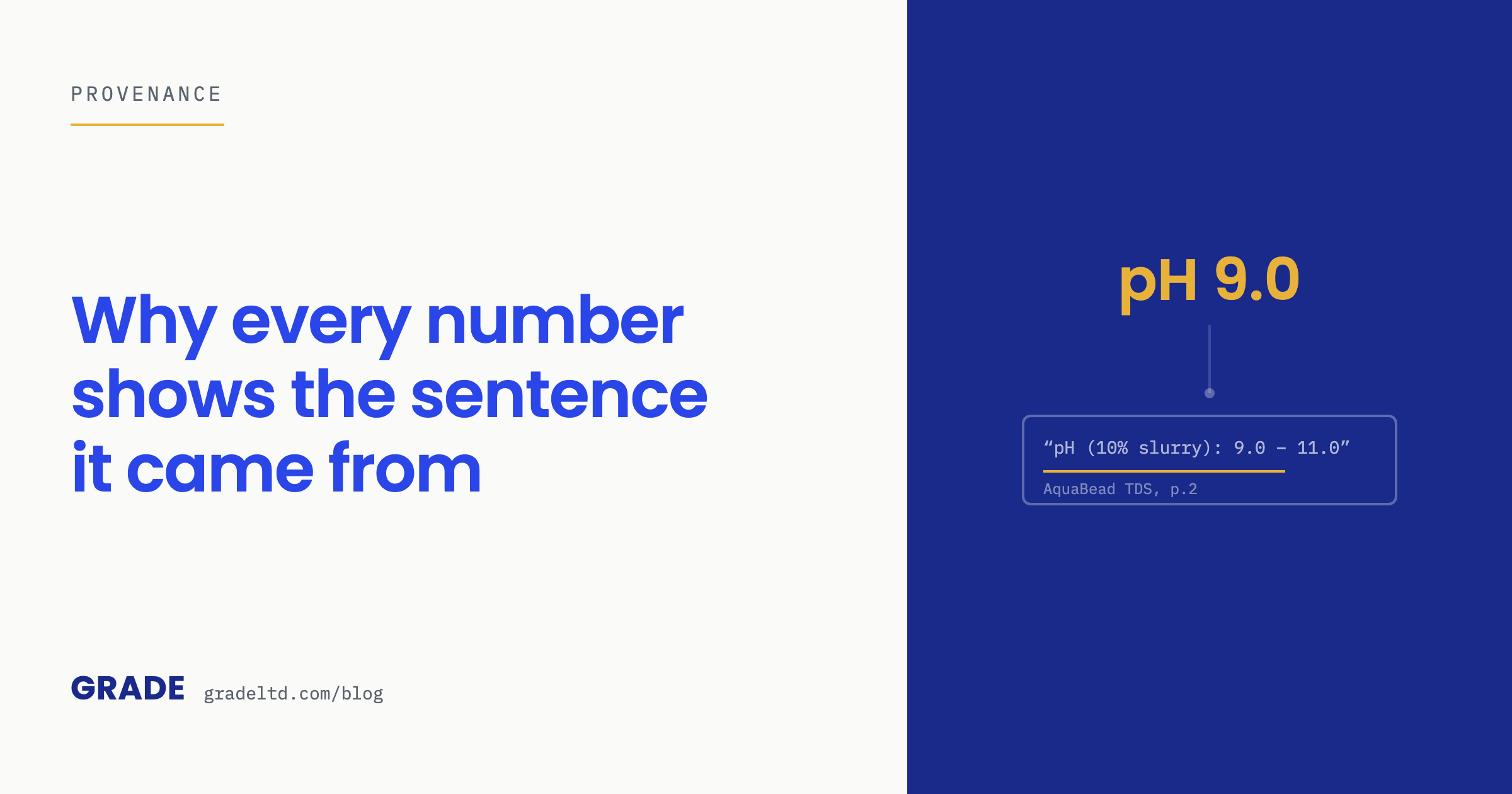
So we made provenance a requirement rather than a feature. Every value the system extracts must correspond to a sentence printed on the source document. The extraction step captures that sentence verbatim alongside the value. If a value cannot be tied to a specific line, it is rejected — not stored with lower confidence, not flagged for review, rejected. The record is incomplete instead of being wrong.
The effect on a demonstration is immediate. When someone sees a product eliminated for exceeding a particle size limit, they can expand the reason and read the exact sentence from their own data sheet that justified it. They are not being asked to trust the software. They are being shown the document they already trust, with the relevant line pointed at.
The effect on the company is more interesting. Once every number must carry a source, whole categories of plausible-sounding output become impossible. The system cannot average two conflicting values into a reasonable-looking compromise. It cannot infer a maximum from a mean. It cannot fill a gap with a number that is probably about right. Each of those would be a small, defensible-seeming shortcut, and each would eventually produce a confident error nobody could explain afterwards.
Regulatory text gets the strictest treatment. Compliance statements are reproduced word for word, never summarised into a checkbox. A sentence like "conforms to (EU) 2019/1021 and the Stockholm Convention on Persistent Organic Pollutants" contains qualifications that a paraphrase destroys, and the person reading it downstream will quote it in their own documentation.
There is a broader principle here that applies well beyond our product. As software takes over more of the reading and summarising that people used to do, the question that determines whether it can be trusted with consequential work is not how capable it is. It is whether it can show you where each claim came from, and whether it refuses to answer when it cannot.
We would rather return an incomplete answer with citations than a complete one without.