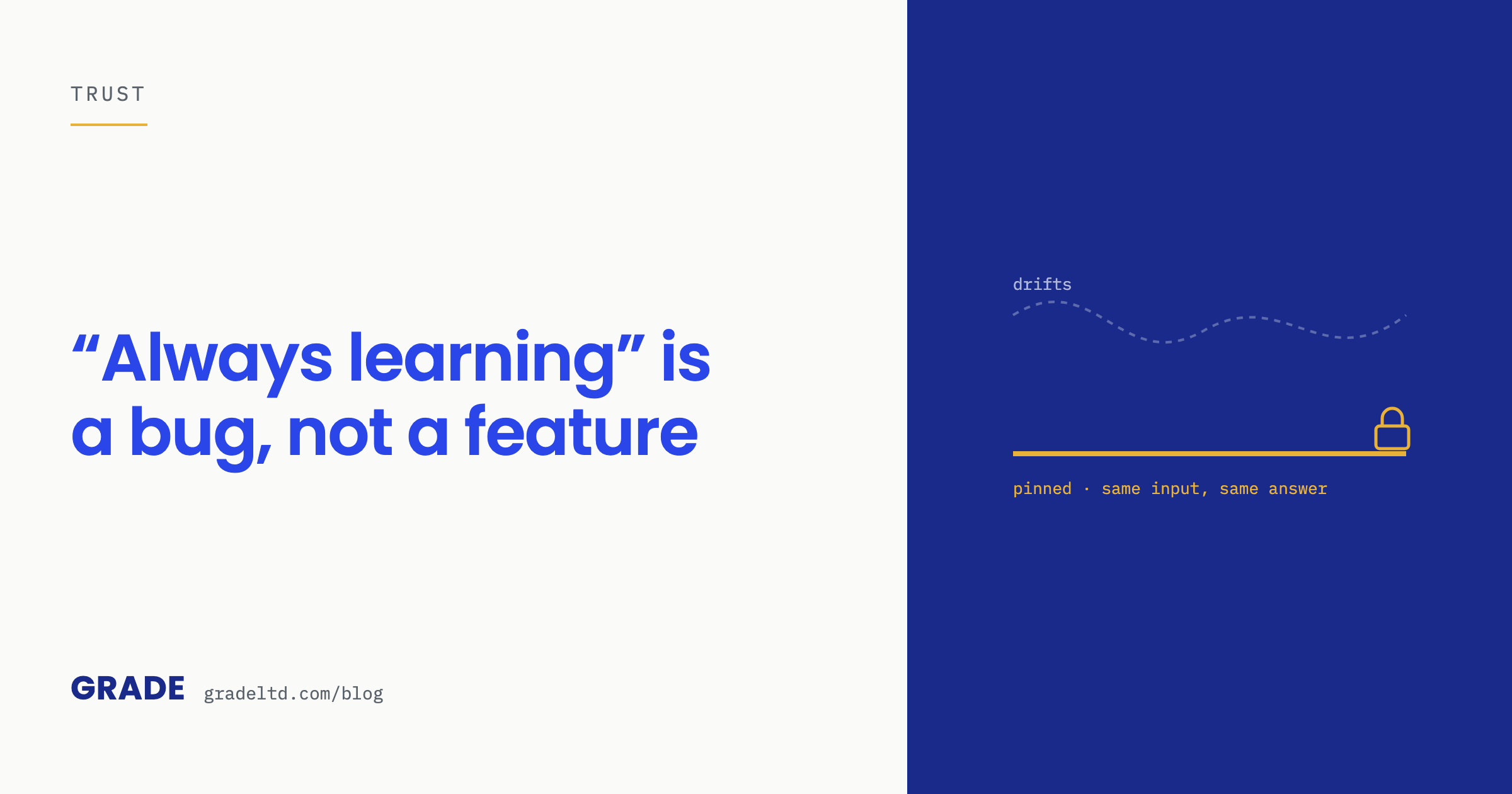
A common selling point for AI products is that they improve continuously. The system learns from every interaction and gets better over time, on its own.
Consider what that sentence means to someone whose product can be rejected over a single specification.
It means the software may answer a question differently in March than it did in January, for reasons nobody can reconstruct. It means a validation performed during evaluation describes a system that no longer exists. It means that if a recommendation turns out to be wrong, the version that produced it cannot be examined, because it has already changed.
In most software, silent improvement is a benefit. In a regulated technical industry, it is an audit problem.
Our approach is deliberately old-fashioned. The system's behaviour changes only when we release a new version, and a version is only released if it passes an evaluation suite with a hard requirement that no product violating a constraint ever reaches the output. Releases are numbered. The version in use is visible in the product. If a result needs to be explained six months later, the version that produced it is known and its test results are recorded.
That does not mean nothing improves. Every recommendation, every edit a representative makes to a draft, and every recorded outcome is captured. That record is what makes the product better — for that customer, on their catalogue, using their results. But it is applied through a release that has been tested, not absorbed silently into behaviour overnight.
The distinction is between a system that improves and a system that drifts. The first can be measured, described and validated. The second can only be trusted.
There is an obvious commercial reason to prefer the exciting version. Continuous learning is easier to market than versioned releases and evaluation gates. It sounds like the future. Versioned releases sound like enterprise software from 2009.
But the buyer we care about has been sold the exciting version before, by vendors whose products were unpredictable in ways that cost them time. The question they actually ask, once past the demonstration, is some form of: can you tell me why it said that, and will it say the same thing tomorrow?
We would rather be able to answer yes.